A project manual built right means the contractor has almost no questions, the owner calls to say it was the smoothest project they've run, and construction admin closes out profitable.
Principal-level specifications, without a full-time hire. I write specs that hold up.


24+ YEARS
ARCHITECTURE, SPECIFICATIONS, AND ESTIMATING.
$2 BILLION
HAWAII AND PACIFIC CONSTRUCTION ESTIMATES PRICED.
CLIENTS I'VE WORKED WITH:
INK ARCHITECTS • AM PARTNERS • BKF & ASSOCIATES • ARCAT
WHO YOU'RE WORKING WITH



Vinson Hiraoka
AIA, CSI, CCP
Aloha! I've been the architect who selected the products, the estimator who priced them, and now the specifier who writes them into the construction documents. I support public and private projects in Hawaii and the Pacific from $100K to $100M.
That combination is why the specs hold up when somebody prices them. I started Spesify because Hawaii architecture firms deserve professional spec writing without a full-time hire. Every engagement comes directly through me. Principal level. No juniors, no handoffs.
I also work with mainland firms on their Hawaii projects, bringing local knowledge on codes, construction methods, product availability, and which vendors are worth your time.
Ready to talk about your next project?
WHY SPECS FALL THROUGH THE CRACKS
Specs need a specialist.
Most firms can't staff one.
So specs land on the principal or the project architect. Usually at night. Usually on a weekend.
Nothing about that is a failure of effort. The office master is old because nobody has time to update it. Standards moved on. Sections went missing. That's what happens when the work has no owner.
You know what good specs look like. You want them. What's missing is the time, the fee structure, and a current office master. That's the gap Spesify was built to close.
The Fee Problem
Spec fees usually stay invisible. No line item in the proposal, just a few extra hours folded into drawings or project management. That's a reasonable response to a competitive market, and most firms do it.
The trouble is the fee stops matching the work. Specs get whatever the budget allows, which is rarely enough. Then RFIs and change orders eat the construction admin fee, and the project closes out thinner than it should have.
That's the part worth pulling into the light. Not because the pricing was wrong, but because the cost is showing up somewhere else.
The Time Problem
Drawings come first. Specs come last. They get whatever hours are left, which usually means 8pm on a Sunday before a Monday deadline.
So the master comes out. It might be MasterFormat 95, untouched for years. Products discontinued, references superseded, and nothing checked against the current drawings. The realistic move is to copy from the last project and hope nothing important got missed.
None of that reflects on the person doing it. Architecture school teaches design, not specifications. Most of us picked this up on the job, between deadlines. It's a real discipline, and it takes real time.
The Construction Problem
Hawaii is a small market. Documents get read closely, and experienced owners know to look there first when a job gets rocky.
RFIs are where it shows up. Each one is thirty minutes of attention, sometimes more. Some take days. None of that time was in the fee, and it comes out of the phase where your margin lives.
Most of it traces back to the same place. A section that didn't match the drawings. A product that wasn't available. Language that left room for interpretation. Small things at the document stage, expensive ones during construction.

A SOLUTION FOR YOUR SPECIFICATION PROBLEMS
Get a complete, coordinated project manual.
Ready for bid. Delivered on time.
I understand your pain points. Here's what your specs can look like:
A Thorough Drawing Review
Before starting, your entire drawing set is reviewed to understand the scope of work and requirements for the entire project. After that, architectural drawings are zeroed in on. Every sheet, every detail.
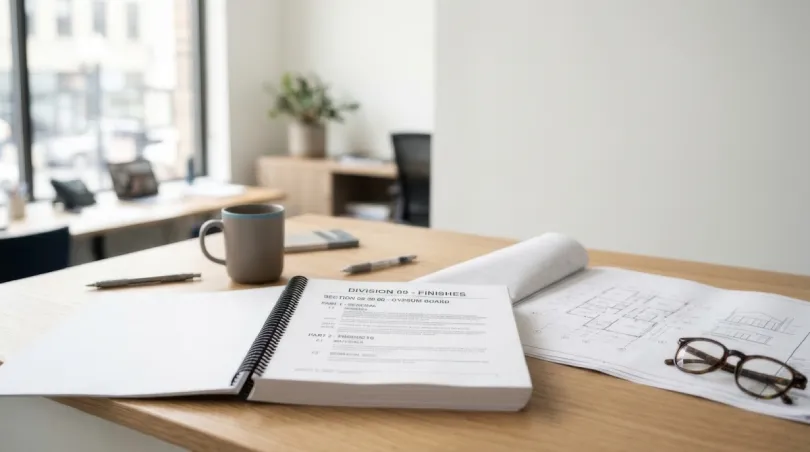
Division 00 Guide Specs
If the owner does not have Division 00 procurement documents, I can provide AIA MasterSpec guide specifications for customization.
Division 01 General Requirements
Division 01 sections edited for your specific project, delivery method, and owner requirements. These are generated from AIA MasterSpec guide specifications which are the leading industry standard.
Complete Architectural Specs
Each architectural spec section is based on AIA MasterSpec guide specs and customized for your project needs. If custom sections are required, I can create these following best practices.
Full Project Manual Compilation
I collect Divisions 00 and 01, architectural sections, and all consultant sections. These are compiled into one unified project manual delivered to you in PDF format for your review.
Industry Standards
All specs are coordinated, current, and formatted to MasterFormat 2020. Hawaii State and City projects are formatted using MasterFormat 95, their current legacy standard.
Drawing Coordination and Alerts
Every spec section is reviewed with your architectural drawings. If something doesn't line up, you hear about it before the submittal deadline, not during construction. That's another set of eyes on your set, from someone who has priced this kind of work and knows where the gaps show up.
Cloud-Based Review Workflow
All spec review comments are tracked through Autodesk Forma Build. Your team reviews, approves, and responds to each comment in one place. No lost emails. No version confusion.
In-Person or Online Meeting Support
If your team needs to walk through the specs and discuss issues in-person or online, I am available. Walking through the specs together is often where the real risk gets caught.
Quality Control Review
Technical peer review of drawings and specifications before bid, available to firms I already work with. A second read on the documents while there's still time to fix what turns up.
THE SPESIFY STANDARD
Every project manual I deliver is written to current standards, coordinated with your drawings, and ready for bid at final submittal. If something is missed on my end, I'll fix it. No arguments. No additional fees. This is the standard every deliverable is held to.
Easy to work with.
Accountability and Trust
Your success is my success. I take accountability for my performance seriously. Trust is earned every single day, not assumed at the start.
Relationships With Aloha
I know what local relationships, culture, and communication are worth here. Respect, responsibility, and humility are core beliefs, not a tagline.
No Aggravation Policy
TURNAROUND TIMES
Specs delivered on schedule, every time.
Two submittals are standard on every project. Prefinal specs at Design Development. Final specs at Construction Documents. Standard revisions are included at no additional fee. Here's an idea of delivery times.
REPAIR AND MAINTENANCE
2 to 4
weeks total
Full spec set across two submittals. Each submittal delivered in one to two weeks. Revisions from the first phase incorporated before the final delivery.
NEW CONSTRUCTION
4 to 8
weeks total
Full spec set across two submittals. Each submittal delivered in two to four weeks depending on project size. Larger, more complex projects may take longer.
QUESTIONS FIRMS ASK ME
Fair questions. Here are straight answers.
"I can't afford to add a spec consultant to my fee."
The cost is already in your fee. It's just buried in drawings or PM hours, and it rarely covers what the work takes.
Pull it out as its own line item. The work gets done right for close to what you're spending now. And you stop paying the hidden part. That part is your evenings, plus the RFIs a rushed document creates.
Most firms find the math works better than they expected. If it doesn't work on your project, I'll say so at the discovery meeting.
"I'm already stretched thin. How does hiring someone help?"
Fair question. Bringing someone in usually means more coordination, not less.
Here's what it takes from you. Send me the drawing set. Give me one short call to go over the project. From there I review the full set myself. Questions come to you in batches, not a steady trickle. All review happens in Autodesk Forma Build, so nobody hunts through email for the current version.
That's the whole ask. What you get back is the piece that's been landing on you last, under deadline, on a Sunday night. That's the worst time to write the document that governs how the project gets built.
"I can write the specs myself. I've always done it that way."
No argument. Most principals can, and many do it well.
I'm not replacing your judgment. I'm a second set of eyes from someone who has priced this work. I've been the architect picking products and the estimator pricing them. So when a section won't hold up under a contractor's pencil, I usually catch it early.
Then there's maintenance. Spec masters have to stay current. Reference standards change. Products come and go in the local market. That work never stops, and it's the first thing to drop when a deadline hits. I keep up with it because it's my whole job, not something I squeeze between deadlines.
"Our specs have been good enough."
Often true. If your projects close out clean, that counts for something.
Trouble rarely shows up on the average project. It shows up on the odd one. An unfamiliar assembly. A product that gets discontinued mid-design. A contractor hunting for room in the documents. That's when a section that's been fine for years stops working.
If that's not happening to you, you probably don't need me yet. If it is, let's talk.

GETTING STARTED IS EASY
Three simple steps and your specs are handled.
STEP 1
Contact Spesify.
Reach out to me using the web form below, email, phone call, or direct messaging on LinkedIn.
I'll respond to you within one business day or less.
STEP 2
Let's Get Acquainted.
I'll schedule a discovery meeting with you either in-person or online. Let's get to know each other, go over your company profile, project needs, and make sure Spesify is the right fit.
STEP 3